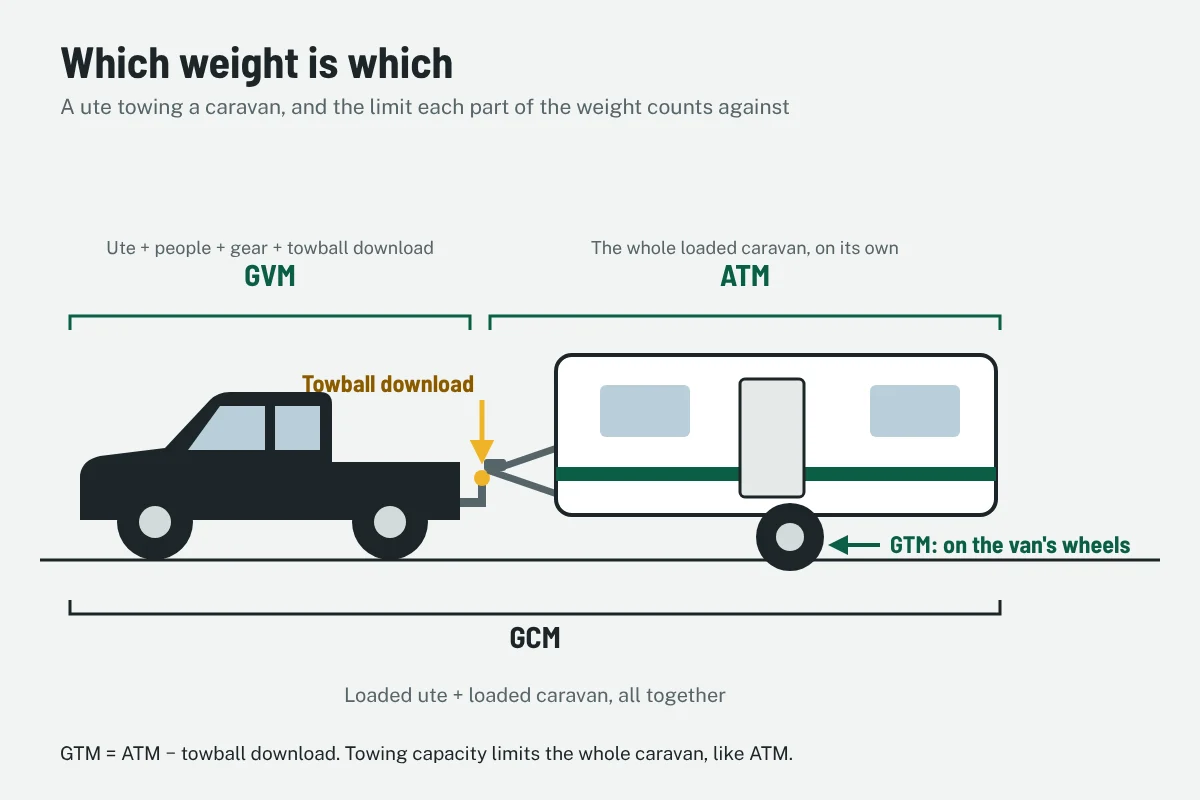
Towing in Australia comes down to a handful of mass ratings with similar-sounding names. They are easy to mix up, and mixing them up is how people end up overweight without knowing it. This guide explains each one in plain terms, shows where to find it, and then puts them together for one ute and caravan.
The short version
| Term | Stands for | What it limits |
|---|---|---|
| Tare | Tare mass | Nothing. It’s the empty starting weight. |
| GVM | Gross vehicle mass | The loaded tow vehicle, including towball download |
| ATM | Aggregate trailer mass | The loaded trailer, weighed on its own |
| GTM | Gross trailer mass | The weight on the trailer’s own wheels when hitched |
| TBM | Towball mass (download) | The weight on the towball |
| GCM | Gross combination mass | The loaded vehicle and loaded trailer together |
The towing capacity (sometimes called the braked towing capacity) is a separate figure from the vehicle maker. It limits how heavy the trailer may be.
Vehicle terms
Tare and kerb weight. For a vehicle in Australia, tare mass is the empty vehicle with all its fluids but only 10 litres of fuel. Kerb weight, the figure most manufacturers publish, is the same with a full tank. Neither includes accessories fitted after the factory, people or gear.
GVM. The most the vehicle may weigh, loaded, on its own wheels. When you’re towing, the towball download is resting on the vehicle, so it counts towards GVM just like a passenger. GVM is on the vehicle’s plate or in the owner’s manual.
Payload. Not a rating as such, but worth knowing: GVM minus kerb weight. It’s what you can add to the vehicle in accessories, people, gear and towball download. The payload calculator adds it up.
Towing capacity. The heaviest trailer the vehicle maker allows. Most vehicles have a lower unbraked figure (often 750 kg) and a higher braked figure for trailers with brakes. Transport for NSW notes that if a manufacturer gives no towing figure, the limit is 1.5 times the vehicle’s unladen mass for a trailer with working brakes, and the vehicle’s unladen mass for a trailer that doesn’t need brakes.
Maximum towball download. The most weight the vehicle can take on its towball. It’s in the owner’s manual and is often around 10% of the braked towing capacity.
GCM. The most the loaded vehicle and loaded trailer may weigh together. It’s set by the vehicle maker and is the figure people most often forget. On many vehicles GVM plus towing capacity adds up to more than the GCM, which means you can’t max out both at once. Our guide on why a 3,500 kg towing capacity often isn’t 3,500 kg covers this in detail.
Trailer terms
These come from Vehicle Standards Bulletin 1 (VSB 1), the national standard for trailers up to 4.5 tonnes. VSB 1 requires a trailer’s compliance plate to show its ATM, GTM and tare mass.
Tare. The empty trailer, ready for service with its standard equipment. Anything added after it was plated, such as batteries, solar panels or an annex, adds to the real tare.
ATM. The total mass of the trailer carrying the maximum load the manufacturer recommends. It includes the part of the trailer’s weight carried by the towball. Weigh the loaded trailer on its own, standing on its jockey wheel, and you have its actual ATM.
GTM. The mass the trailer’s tyres put on the ground when it’s hitched and fully loaded. It leaves out the towball download. So GTM is always lower than ATM:
GTM = ATM − towball download
Towball download (TBM). The downward force the trailer puts on the towball, measured in kilograms. It’s also called ball weight, nose weight or tongue weight.
How they fit together
Picture the trailer’s weight being split between two places when you hitch up. Most of it sits on the trailer’s wheels (that’s the GTM part), and the rest sits on the towball (the towball download). The towball download then becomes part of the vehicle’s load.
That gives four checks that must all pass:
- Loaded vehicle + towball download ≤ GVM
- Loaded trailer ≤ towing capacity (and the trailer’s own ATM, and the towbar’s rating)
- Towball download ≤ maximum towball download
- Loaded vehicle + loaded trailer ≤ GCM
For the GCM, it doesn’t matter how the trailer’s weight is split. The whole rig is weighed together.
Worked example
Take a dual-cab ute with these figures:
- Kerb weight 2,250 kg, GVM 3,200 kg, GCM 6,000 kg
- Braked towing capacity 3,500 kg, maximum towball download 350 kg
It has a canopy, drawers, a bull bar and a towbar (250 kg), two people (160 kg) and gear (150 kg). Loaded, unhitched, it weighs 2,250 + 250 + 160 + 150 = 2,810 kg.
It’s towing a caravan plated at 3,000 kg ATM and 2,750 kg GTM. Packed for the trip, the caravan weighs 2,900 kg on its own, with 290 kg on the towball.
| Check | Sum | Limit | Result |
|---|---|---|---|
| GVM | 2,810 + 290 = 3,100 kg | 3,200 kg | 100 kg spare |
| Towing capacity | 2,900 kg | 3,500 kg | 600 kg spare |
| Caravan ATM | 2,900 kg | 3,000 kg | 100 kg spare |
| Caravan GTM | 2,900 − 290 = 2,610 kg | 2,750 kg | 140 kg spare |
| Towball download | 290 kg | 350 kg | 60 kg spare |
| GCM | 2,810 + 2,900 = 5,710 kg | 6,000 kg | 290 kg spare |
Everything passes, but the vehicle has only 100 kg left under GVM. A full 80 litre water tank at the front of the van, or a second fridge in the tray, could take it over.
You can run your own numbers through the towing calculator, which does all six checks at once.
Where to find each number
- Vehicle GVM, GCM and towing capacity: the compliance or VIN plate (often in the driver’s door opening), the owner’s manual, or the manufacturer’s specifications for your exact variant. Figures can differ between variants of the same model.
- Maximum towball download: the owner’s manual.
- Towbar rating: stamped on the towbar. NSW requires a rating label on towbars fitted to vehicles built after 1 January 1992, unless the towbar is a permanent part of the vehicle.
- Trailer ATM, GTM and tare: the trailer’s compliance plate, usually on the drawbar.
- Your real weights: a public weighbridge. The weighbridge calculator turns the readings into GTM, towball download and trailer weight.
Common mix-ups
Treating ATM as what the trailer weighs. The ATM on the plate is a limit. What your trailer actually weighs depends on how you’ve loaded it.
Forgetting the towball download on the vehicle. It’s easy to check the vehicle’s weight before hitching and think you’re under GVM. Hitch up and add the towball download.
Using tare instead of real weights. Tare figures leave out accessories, and for vehicles they assume only 10 litres of fuel. Start from a weighbridge reading if you can.